The first thing I learned at business school was that I sucked at making slides. My peers, who had spent years at companies like McKinsey, could make presentations in their sleep; one bragged to me that he could tell from a metre away if something was “off by one pixel”. I, on the other hand, had interviewed central bankers and chief executives as a business journalist, but had never had to “convince stakeholders” in 16:9 resolution.
I resented it. Making slides felt unnatural. So I was relieved when I started working in tech and met people who preferred communicating with short memos. Generative AI arrived, and colleagues started creating miniature websites instead of decks. In February, investors wiped nearly a trillion dollars off US software stocks on the bet that AI would make much of today’s software obsolete, a dip christened the “SaaSpocalypse”, and in April, Anthropic launched Claude Design, which lets users describe a deck, a one-pager or a prototype in plain English and get back a polished version in minutes.
Hope filled my hardened heart. Maybe the power of PowerPoint, which has minted at least two billionaires and been called the “third American art form”, was waning.
I decided to test my hypothesis by speaking with a dozen consultants, AI-powered presentation-tool builders, and investors about their views. In the process, I came to understand why PowerPoint and the slide have endured. But the ways “the presentation” is changing offer a test for the rest of our working lives: a way to tell, as AI arrives, what will stay and what will change.
The history of PowerPoint and why tech execs hate it
One of my earliest memories is of my French teacher showing us vocabulary on a projector. She wrote each word on a transparent slide using an erasable pen, and a mirror in the machine threw an enlarged image on the wall — salon, cuisine, salle de bain — for us to copy.
This was the same setup for managers well into the 1990s. A department head who wanted to show the quarter’s sales sketched the graphs by hand and sent them to a graphics department, which turned them into transparencies or 35-millimetre slides days later. A mistake meant starting over. Only the most important presentations got cinematic treatment: “multi-image shows” with lights, music, and a fleet of projectors synchronised by cue machines, like something out of Star Wars.
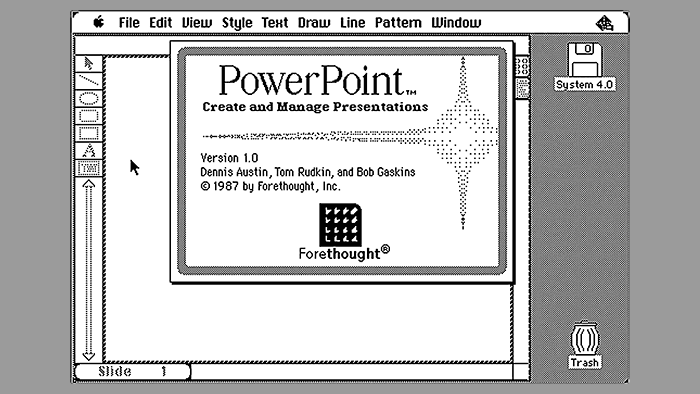
The man who changed this was Robert Gaskins, an American literary scholar who had run computer-science research at Bell-Northern Research before joining a struggling Silicon Valley startup called Forethought in 1984. He cared about clear communication in a way that most software designers of the era did not, and predicted that “presentations will become one of the broadest and largest horizontal applications for personal computer software”. With developer Dennis Austin, another literature enthusiast, he built a programme called Presenter, which was later known, for trademark reasons, as PowerPoint.
In 1987, Microsoft bought Forethought for $14m in cash. Bundled into Office, PowerPoint had an estimated 95% of the market by 2003. Today, PowerPoint plug-in maker Thinkcell estimates that the software has more than 600m professional users.
But with success came opposition. In 2003, design critic Edward Tufte published an essay in WIRED under the headline “PowerPoint Is Evil”, with a subtitle that riffed on Lord Acton’s dictum: “power corrupts; PowerPoint corrupts absolutely.” Tufte later blamed a single badly built NASA slide for causing managers to dismiss the foam strike that caused the space shuttle Columbia to break apart in 2003, killing the astronauts on board. General Stanley A. McChrystal, then America’s commander in Afghanistan, shown a brainbuster of a slide on the US’s strategy, quipped, “When we understand that slide, we’ll have won the war.”
In 2004, Amazon founder Jeff Bezos banned PowerPoint from senior-team meetings in favour of memos because “the narrative structure of a good memo forces better thought”. Scott McNealy, the CEO of Sun Microsystems, went further, banning PowerPoint at his company; according to Gaskins’s own history of PowerPoint, in 2001 McNealy cheekily observed a correlation between the ban and Sun’s soaring share price. This correlation, Gaskins notes, did not last long. (Sun Microsystems’ share price peaked in September 2000.)
Yet for all the sniping, PowerPoint’s enemies were critics rather than competitors. Google Slides, Apple’s Keynote and start-ups such as Prezi won converts, but none dislodged PowerPoint from the corporate desktop. To do that, it seemed, would take something new.
How AI changed slide-making
I called some people to find out.
Halfway through our call, Tobias Haefele interrupted me. “Do you want to see 50 dense slides?” It’s an invitation I dared not refuse. The screen begins to scroll: the executive summary, an analysis of how defensible a German company’s software is, competitive position, estimates of its revenues until 2030…
He was showing me a slide deck created for a private-equity firm deciding whether or not to buy a company, and Haefele’s team created the analysis within three days of the team getting access to a data room. “Even to me, it’s insane,” said Haefele, chief executive of Riplo, who did stints at McKinsey and its AI arm, QuantumBlack. The company does consulting work for private equity firms and has built its own software to make the content; its three engineers sit opposite Riplo’s four consultants.

A year ago, Haefele estimated, a “chunky team” would have needed two to four weeks for similar work. When the client asked for some of the numbers to be recalculated, changes took 25 minutes, rather than a very late night deep in Excel. “Even five months ago, if you’d asked me, is this going to be possible at any point? I’d say, no.”
The technologists and investors I spoke to about generative AI speeding up the automation of slide making mentioned several innovations. First, some models are capable of independently completing tasks that would take a human over five hours, versus four minutes in 2023, according to METR, a non-profit that tests AI systems. The second is sight. Models used to be unable to tell where text would wrap or shapes would collide. Google’s Gemini 3 Pro, released in November 2025, scored 72.7% on how well it could locate and interact with user interfaces of common software such as PowerPoint and Photoshop; its predecessor only managed 11.4%. Anthropic released Claude Design on Opus 4.7, which, at the time, it touted as its most capable vision model. Model output is more accurate, and the cost of using the latest models has come down drastically.
Riplo makes a 20-page deck, research included, for ten to twelve dollars in tokens, Zack Zornitta, Riplo’s chief technology officer, told me. The team confirmed to me that their rates for a diligence project match the top strategy firms, but “because a diligence takes us days rather than weeks, the total cost [to the client] ends up closer to what a fund would pay a mid-tier advisor.”
Together, these make slides cheaper and easier to automate. Gamma, Beautiful.ai and Canva promise polished slides to people who, like me, never learned to make them and don’t have a design department behind them. (Second Chapter’s pitch deck was made with Gamma.) Riplo serves the investors and consultants for whom decks are the deliverables. Dense with data and footnoted, these are the slides that clients pay consultants handsomely for. These decks are read, not presented.
Zornitta believes that AI will make individual slides themselves richer and more interactive. Today, he said, if a slide says a market is growing 12% a year, someone has to trace by hand which document and which analysis produced the figure. In the future, a client “might see something that looks really interesting on slide 47. Their agent can interact and go a level deeper.” The deck becomes, in his words, “a store of analysis more than just the last mile.”
Tying together the research and the output more closely is “over the longer term really what excites me the most, but is also the largest technical lift,” he says.
A consultant at a large firm in the Gulf imagines something similar: a deliverable that keeps updating as markets and economies move. Even in his version, though, the client starts with a short deck of ten or fifteen slides.
The moat around PowerPoint and slides
No one has yet toppled PowerPoint or the slide format.
All of the disrupters still have a way to export slides to PowerPoint. Management consulting firms, PowerPoint’s most devoted users, are building serious AI slide tools in-house, but they sit on top of Microsoft’s software rather than replacing it. McKinsey’s consultants now create PowerPoint slides from prompts using agents inside Lilli, the firm’s in-house AI platform. “Do we need armies of business analysts creating PowerPoints? No, the technology could do that. Is that a bad thing? No, that’s a great thing,” Kate Smaje, its global leader for technology and AI, said in 2025. At BCG, consultants use Deckster, a PowerPoint plugin trained on 800 to 900 slide templates, to build or polish slides.
Even Riplo’s slide editor mimics PowerPoint, making it easier for consultants to adopt. “When you’re running a live project, and it’s two in the morning, and you’re tired, you just want it to work,” Zornitta explained.
No company understands the power of PowerPoint better than Thinkcell. It was founded in Berlin in 2002 by two computer scientists, Arno Schödl and Markus Hannebauer, and creates add-ons for the most discerning PowerPoint users. The company’s waterfall charts and Harvey balls are now the visual dialect of consulting slides, generating annual recurring revenue of €200m with 1.4m customers. Alexander von Fritsch, its chief executive, learned how to use Thinkcell at McKinsey two decades ago.
Thinkcell has also implemented features that use generative AI, but von Fritsch wants to keep some things human. Thinkcell’s new AI Suite does not produce a finished slide in one go. It writes a storyline and an outline first, subject to user approval. “I don’t believe in one-prompt or one-shot generation of slides,” he said. “Not for the presentations we build.”
Some of PowerPoint’s longevity is bolstered by the ubiquity of Microsoft tools in companies of all sizes. Most large companies buy Microsoft 365 for every employee, and with Copilot on top of that, the costs add up. “They aren’t just going to drop PowerPoint for another tool and suddenly pay for that other tool for another 6,000 people,” says Fiona Walsh, a corporate trainer in Cork and one of only 32 people worldwide whom Microsoft recognises as outside experts on PowerPoint.
Microsoft itself has not stood still. In 2025, it introduced PowerPoint agents, allowing users to directly create slides just by chatting with AI assistant Copilot.
Beneath presentation software sits an even more durable format: the slide itself. Consultants tell me that the rectangle has survived because it is a finite canvas, and pruning your recommendations to fit within its four walls helps structure thinking. Jean-Antoine Bechara, strategic advisor to the CEO at SigmaRoc, said his previous role as a consultant was important grounding: “The process of designing the slide helps me think.”
Thinkcell’s von Fritsch argues that slides give a snapshot of a situation at a fixed moment in time. Decision-makers are drowning in more analysis than ever, “but the decision-maker still only has 24 hours a day”, he says. They need to make a decision on a fixed artefact, so they can go back to it weeks later and understand why they made that call then and on what evidence. An AI-generated dashboard that constantly updates may not provide this audit trail.
Bechara says the physicality of the slide deck is also important for in-person meetings and relationship building. “If you discuss something with a banker, you bring a book of slides, an artefact. This printable format is part of the relationship,” he says. “In a board meeting, you don’t want people working on their laptops. You need something that maps to a page so people are there in the moment for the important meeting.”
Yet Bechara says that AI has allowed him to be more nuanced in his communication, and he converts slides into HTML sites for his CEO to quickly review when the executive has limited time. “I’m communicating the same information, but in a user-friendly way that is adjusted to my audience.”
The slide shape may even be written into our biology. “Look at how every TV screen is designed. It’s a 16:9 format,” von Fritsch said. “It is how our eyes range horizontally to consume information.” Grant Lee, chief executive of Gamma, an AI presentation maker that passed $100m in annual recurring revenue in 2025, would like to see the static slide disappear. Yet even he reached for the cinema to explain why it has lasted so long. A film, he said, is just frames lined up in a particular order, “and so a story needs to be told in that sort of linear order.”

How consultants learn when making slides is easy
So automation may not be threatening the slide itself, but consultants and business leaders are concerned that if slides are too easy to create, younger professionals may not learn the same critical thinking skills as previous generations.
The Gulf consultant tells me that slides taught him to think and problem-solve. "When you’re doing the slides, you’re not just questioning the packaging. You’re questioning the content and the process… If something is missing, it shows you that it is missing."
"Where is this schooling happening in the future? Nobody will go through the rigour as much now. If firms will not hire as many people, and the process is simplified, then how do you learn to become that thorough?" he wonders.
The work also changes for more senior staff. Before generative AI, the bottleneck was how many slides a team could make. Now it is quality control, and it falls on a project manager with the same small team as before and vastly more to review, Thinkcell’s von Fritsch says.
The increase in output to review can be mentally taxing, several consultants told me. Previously, long meetings and even the time spent crafting slides broke up the day and let consultants rest that part of their brains. Now, that’s harder.
Haefele thinks the consulting career ladder will be squeezed from both ends: juniors will have to start thinking much earlier, and partners, who have long treated seniority as a licence to stop making things, will have to remain the experts. PowerPoint trainer Walsh still teaches the fundamentals of laying out a slide, even though Copilot can do it, because a quick tweak by hand is often faster than asking the machine.
The future of presentations and realising our creativity
Russell Davies, a former advertising strategist who wrote a book in praise of PowerPoint, has a theory about why so many powerful people hated PowerPoint. “Journalists and CEOs are anti-presentation,” he said, “because they never have to do that.” In his reading, Bezos’s memos are a monument to the entrepreneur’s impatience. Everyone else isn’t too fussed by a few slides. “If you talk to most people in most jobs, it’s the best bit of their day,” he said. If you work in the finance team, the quarterly presentation might be the only time you get to choose a font, do some design, stand up, and have your boss notice you. “You might get to put pictures of your kids in it. Your dog. For most people, PowerPoint is the most creative they ever get to be.”
But if creativity and expression are the goal — for the presentations that do get presented to a crowd — AI could unlock some pretty nifty things.
Gamma’s Lee imagines presentations you can walk through: instead of a slide with a photo of your childhood bedroom, you could let someone click into the room, pan around it, and zoom in. “It could be much more of a choose-your-own-adventure,” he said. In five years, he predicts, static slides will look like black-and-white film does now. His favourite use of Gamma so far had nothing to do with business: a user made a deck for a nephew who was graduating, a digital scrapbook of photographs, quotes and cards for relatives to fill in, which ended up being passed around three or four generations of the same family.
The screen is changing, too. In a room, Davies told me, an audience looks at your slide for five seconds and then looks back at you. On a video call, they read it for 30 seconds, then pick up their phones. Walsh’s fix is more slides, changed more often, because each change pulls attention back. Davies thinks online presentations will simply become short videos.
PowerPoint creator Gaskins, Davies says, was begged, again and again, to restrict what users could do: fewer fonts, no clip art. He refused. “That allowed for creativity and joy, and people to do extraordinary things,” Davies said. “But it also allowed for a lot of shit.” AI will do the same, on a vastly larger scale. So it will be up to us to figure out what to present. “Writing is thinking,” Davies said. “Presenting is deciding.”
In an era when slides are easy and quick to produce, Davies argues the new proof of effort will be restraint, and perhaps a kind of daring. “We will demonstrate how much care we’ve had by only showing three diagrams and two sentences.”
When I was writing this article, as an experiment, I used Claude Design to create a vintage PowerPoint presentation based on its content — hideous word art and all. When I looked at the agenda slide Claude spat out, I realised the order of my article was flawed. When it was boiled down to five bullet points, it was easy to see that the narrative didn’t make sense. I changed it on the slide and then reordered my article.
Everyone wants to know what AI will change about the way that we work. My investigation showed me that many fundamental things, like PowerPoint, will likely remain the same for the foreseeable future. At the same time, new AI tools such as Gamma and Figma can let people who can afford to be creative make something really different, something that they wouldn’t have been able to make without a designer before. The hardest part will be keeping our brains switched on, no matter what the work is. My business school friend who bragged about being able to tell if a pixel was off — he now brags about being able to tell if copy is AI-written.