I
When I visited my co-founder, John, at his home recently, his three-year-old son had just discovered time. He could grasp that something had happened recently (playing with grandparents last weekend) and feel excited about things to come (another trip to see Grandad). He also realised that he could control the hours to some extent. Instead of refusing to tidy up before bed or eating his vegetables and risking an argument, he could simply suggest doing so "later". His parents saw through this. This did not prevent him from trying the strategy again…later.
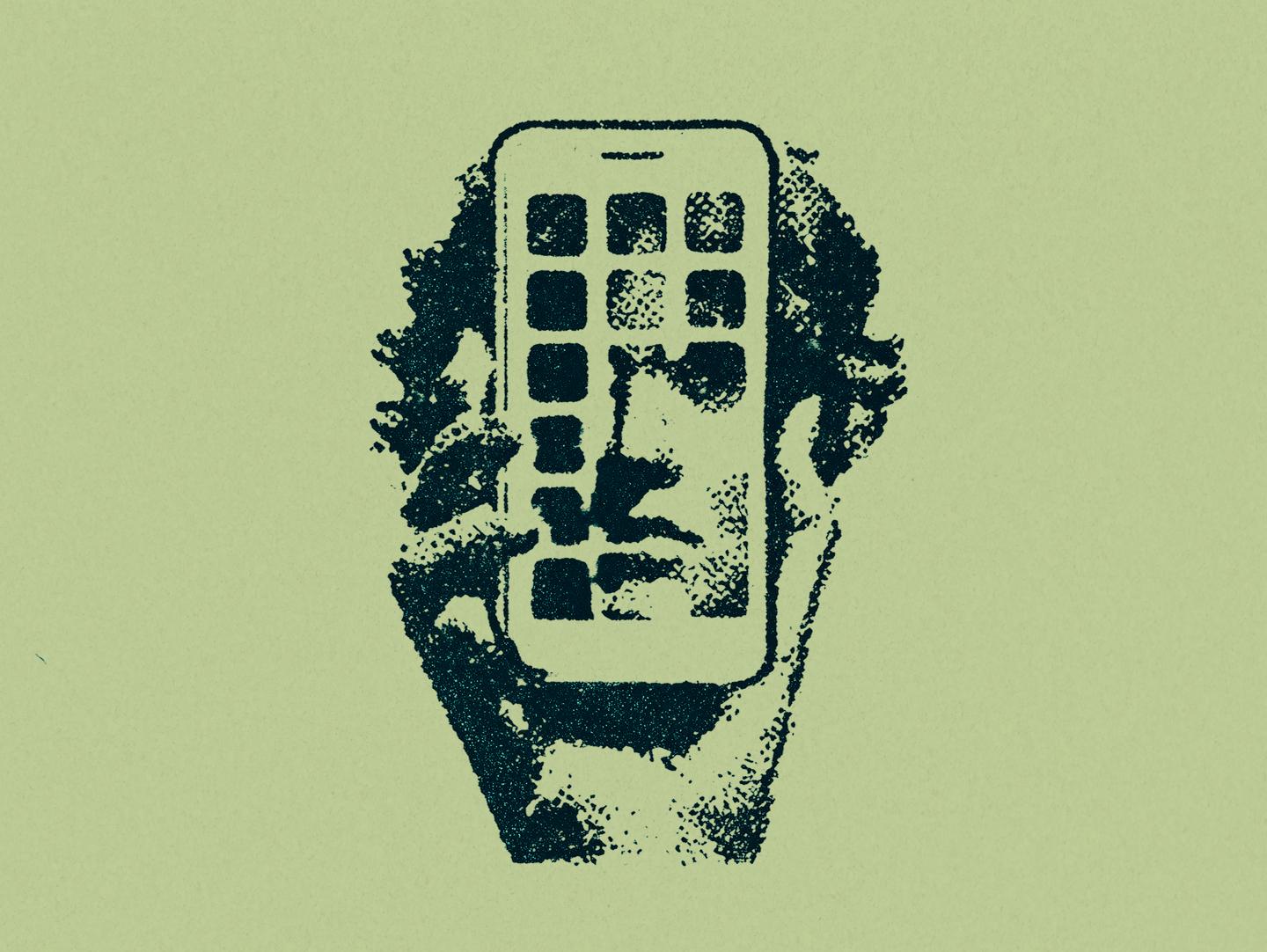
Which made me think that when it comes to our current technology, our society's sense of time seems even less developed than a preschooler's. To work in tech, or to write about it, is to live in a permanent and urgent present. When Mark Zuckerberg tries to sell us a digital personal assistant that looks like a Labubu, I wonder why no one remembers last year’s Labubu craze or that a scant three years ago Zuckerberg victimised us all with an eerie hour-long interview from the metaverse. Leaders of AI labs, meanwhile, bombard us with frequent revisions to their forecasts about the advent of something called artificial general intelligence (AGI), a concept no one can agree on how to define. Each new date scrambles our sense of then, now, and “later.”
Working on Second Chapter, which aims to produce long-form journalism about technology with a longer expiration date than traditional news organisations, has forced me to confront a new concept of time. So I went back to a book that has shaped how I think about time.
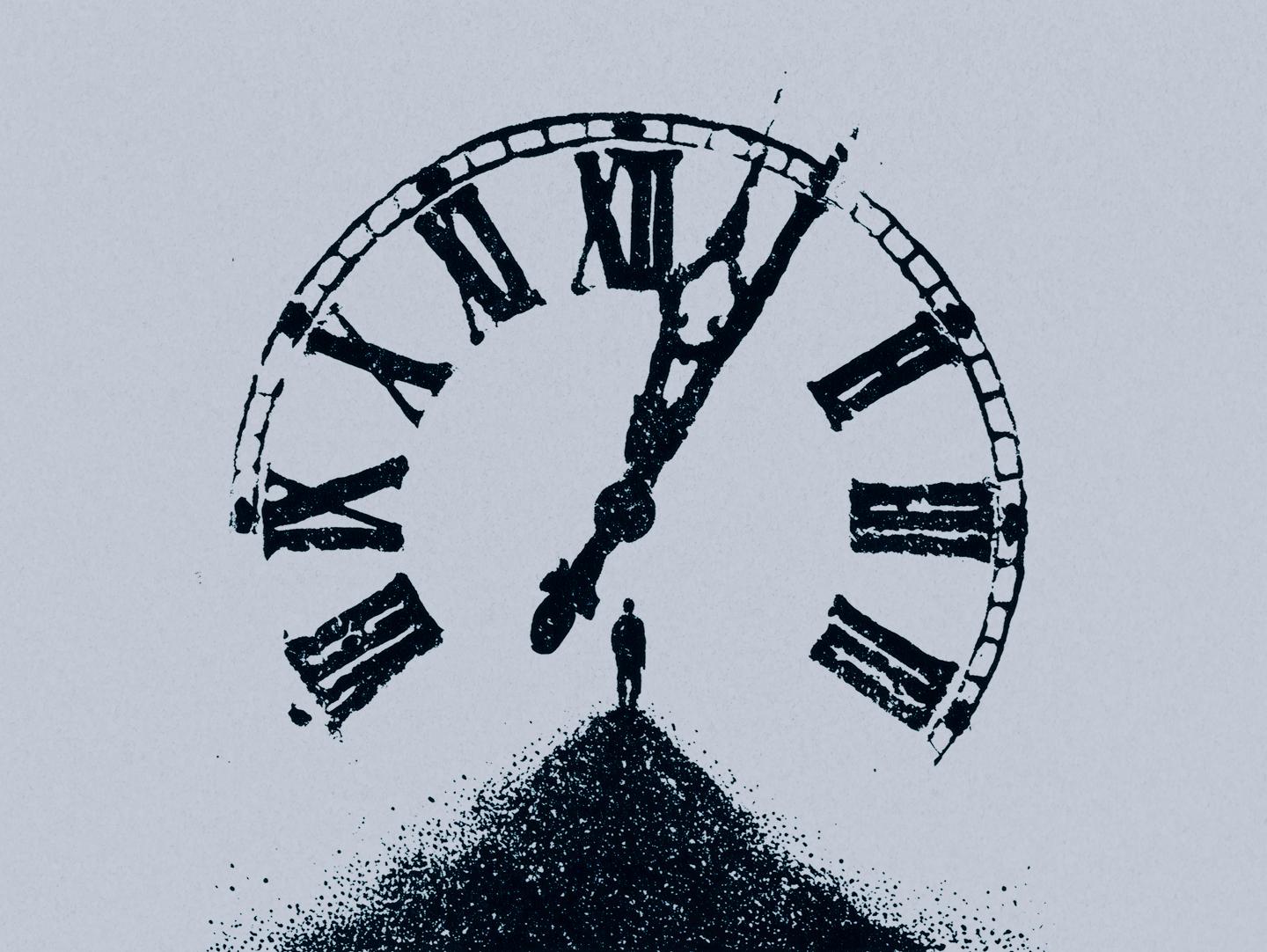
American writer and inventor Stewart Brand’s The Clock of the Long Now: Time and Responsibility was published in 1999, the same year as the Backstreet Boys album, Millennium, which I mention to make 1999 feel real to some of you. It was also the year that Brand and his collaborators finished the first prototype of a clock built to run for 10,000 years, their attempt to make planetary timescales feel real to humans; in short, to “make long-term thinking automatic and common instead of difficult and rare”.
I’ve been surprised at how little Brand is known among people in tech in Europe, despite his influence in Silicon Valley. The "Stay hungry. Stay foolish" line you put in your high school yearbook is Brand, as quoted by Steve Jobs in his 2005 Stanford commencement speech. Born in 1938 in Illinois, Brand is still publishing today; his latest book is Maintenance: Of Everything (Stripe Press).
Brand's argument in The Clock of the Long Now is that our civilisation has grown short-sighted. We run to the schedule of the next quarter or the next election. He argues that we should stretch our sense of the present into a "Long Now": 10,000 years back, and 10,000 years forward. The clock is its symbol: a machine built to make deep time something we can touch and visit, much as cathedrals once made the divine feel close. To explain why we keep defaulting to short-term thinking, Brand offers a framework for how societies change.
II
Brand proposes that systems, from human societies to forests, are layers moving at different speeds. His version of human society runs, from fastest to slowest, through fashion, commerce, infrastructure, governance, culture, and, at the bottom, nature. A sustainable society lets each layer move at its own pace. The fast-moving layers on top inject energy; the slow layers provide stability. “Fast learns, slow remembers… fast gets all our attention, slow has all the power,” he writes.
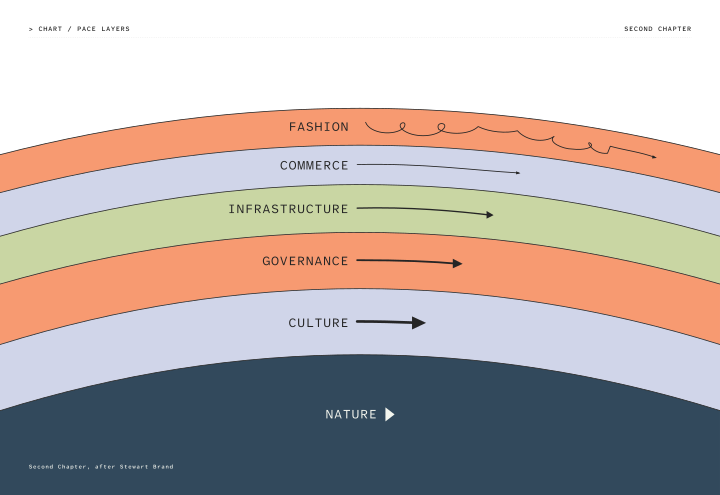
The layers help make sense of today’s jolts (anxiety about AI and jobs, wars old and new, inflation) and of where AI might settle. Technological development — let’s lump it together with commerce — has been kicked into overdrive. OpenAI ships more flagship models than Chanel releases collections. People who work at companies that have given them near-unfettered access to AI tools tell me that many of the AI products and artefacts they’ve made have simply been launched and discarded like fast-fashion T-shirts.
For some, even this is not fast enough. An AI-enthusiast colleague of mine said to me as he went off on summer holiday: “What if AI development continues to speed up so much that I come back and I can’t keep up? Wouldn’t that be cool?” I managed a strained smile. Wouldn’t that be awful?
I don’t think it will happen, no matter how much the thought might thrill some techno-pilled individuals. We have extended our lifespans and are cramming more into our days than our ancestors did, but there are still limits to how much information we can process. People remain the bottleneck to commerce.
Which is why Brand’s layers suggest that the great AI story of the next few years will be as much about implementation as invention: the friction as commerce collides with infrastructure and governance, and slowly seeps into culture.
The layers also explain a mismatch that anyone straddling tech and policy will recognise. Even if AI is moving at the velocity of fashion, regulators work in years. The European Union AI Act was proposed in 2021, and then had to change when ChatGPT arrived halfway through negotiations, and will not enter fully into force until 2028. Britain’s Office for Budget Responsibility forecasts the economy five years ahead, and the EU is now haggling over a seven-year budget that runs until 2034. None of these clocks is wrong, but the trouble starts when the fastest and loudest is treated as the most important, and others are scolded for not keeping up. Brand himself is wary of commerce unchecked: it “may instruct but must not control the levels below it, because commerce alone is too shortsighted”. When we read headlines about AI, we should ask ourselves which clock we are talking about.
III
Journalism sits across all the layers. We write about fashion and quarterly financial results, but also act as a check on the long-term plans of governments and other institutions through our reporting and legal protections for our work. The advent of social media has pushed reporters towards quick hits and headlines. But if AI turns much of today’s news into a commodity, journalism may want room to slow down.
Not that most journalism can be truly long-term; publication timelines and business models see to that. But Brand’s views on how to build resilience into systems offer a little playbook for how journalism can still have impact. He outlines two approaches: “One is to make [changes] small, so the correction is local and quick; the other is to make them slow, so the correction has time to permeate the system.” He states that the scientific paper became popular in the 17th century because it encouraged researchers to add small, quick additions to the stock of knowledge, each one open to correction. This is perhaps what the best journalism can hope to be: small, incremental additions of reporting and analysis — a feature story, a weekly newsletter — that, taken together, further understanding.
In order to do that well, however, our contemporaneous writing needs anchoring in longer trends. One passage in the book stopped me: in 1999, Brand was already noting the rise of gambling in America. Today’s reporting tends to blame sports betting and prediction markets on the smartphone; Brand spotted the trend years before the iPhone. The long view is there if you want to see it.
IV
Not everyone who keeps a longer clock keeps it well. Brand's concern for future generations kept bringing Sam Bankman-Fried to mind. Before his cryptocurrency exchange, FTX, collapsed in 2022 and he was jailed for fraud, Bankman-Fried was one of the best-known backers of effective altruism (EA), a movement that tries to use evidence and reason to do the most good possible. One strand of EA, "longtermism", argues that people living centuries from now matter as much as those alive today, an idea that echoes Brand. Critics argue that, taken to extremes, longtermism lets future suffering outweigh present suffering, though its defenders say otherwise.
Nevertheless, Brand's idea of who counts feels more inclusive. He wants to live 'Big Here' and a 'Long Now', and he is interested in humans across the entire timeline, the dead as much as the unborn, without ranking them. He is not inspired by calculations, but rather moved by stories and symbols, like the idea of a giant clock that can help humans grasp deep time.
A reader today might also find the book strikingly apolitical. Brand writes about genocides and injustices, mostly those that took place centuries before. He argues that to take the long view, you need to stand outside the politics of the moment. Fair enough. But neutrality is a position for the privileged. Fred Turner, a Stanford academic, argues that big corporations co-opted the countercultural idealism about computers that Brand championed. That 10,000-year clock? Bezos is paying for it and building it on land he owns in Texas. It’s ironic that the man who gave us same-day delivery is shelling out for the most durable thing humans have ever made. Brand also casts Europe as a place mired in the past, forgetting that while its churches are old, democracies such as Spain’s and Portugal’s were barely a generation old when he wrote.
V
If commerce runs on the fastest clock, the question is whether anyone in business will keep a slower one. Who are the founders and investors — even the governments — thinking on planetary timescales today? We have to give Jeff Bezos one point here. And grudgingly, we should probably accept Elon Musk as another, given his Martian ambitions. DeepMind, too. Co-founder Demis Hassabis started the company in 2010 with a 20-year plan to reach AGI.
AI has everyone dreaming of the one-person, billion-dollar company. No matter how successful this company is, it cannot outlive its person; its lifespan is inherently capped. This is why I chose to found a company and build a team around myself, instead of just whipping up another Substack and having a go at being relevant. Founding a company and institutionalising thoughts and processes forces us to think longer term.
So, indulgently, we have decided to champion long pieces like this one. Take your time with it; it may still be of use next week or the week after. And if you don’t have time to finish it, you can always come back to it later.